Home / Blog / Crypto Taxes by Country: From 0% Tax Havens to 45% Heavy Hitters
I talk to a lot of P2P arbitrageurs and high-volume crypto traders, and eventually, the conversation always turns to the exact same topic: Taxes.
If you are grinding out 2% margins on complex P2P cross-border trades, handing 30% of your hard-earned profits over to the taxman completely breaks your risk-to-reward ratio. In my experience, once a trader crosses the six-figure profit threshold, their primary bottleneck stops being liquidity and starts being jurisdictional efficiency.
You simply cannot trade optimally if you are structurally disadvantaged by your geography.
So, where are the best places in the world to be a crypto trader right now? If you are looking at trending crypto adopting countries, you need to know exactly how much they will take from your profits before you pack your bags.
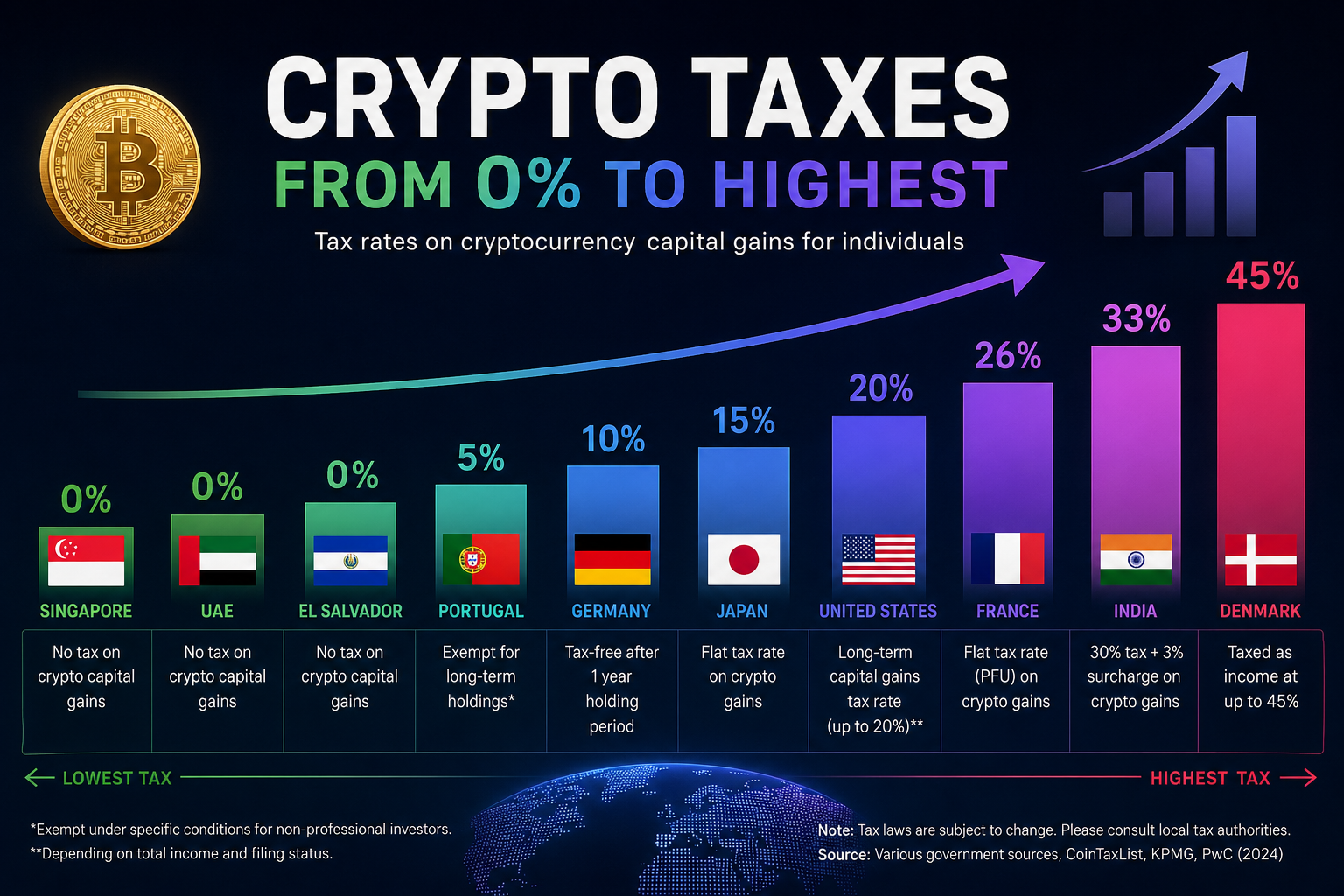
Let's dive into the global landscape of crypto taxes, ranking the major players from the 0% tax havens all the way up to the 45% heavy hitters. We'll also cover emerging hot spots like the Philippines new crypto rules and taxes, and the harsh reality of the Indian stance on crypto.
The Zero-Tax Havens (0% Capital Gains)
Let's start with the promised land. In these jurisdictions, individual investors do not pay capital gains tax on their cryptocurrency profits. If you buy Bitcoin at $40,000 and sell at $100,000, you keep the entire $60,000 spread.
🇸🇬 Singapore (0%)
Singapore has established itself as the premier hub for crypto capital in Asia. The city-state does not have a capital gains tax regime at all. Whether you are trading stocks, real estate, or Ethereum, individual long-term investors walk away with 0% tax liability.
- The Catch: If the Inland Revenue Authority of Singapore (IRAS) determines you are trading crypto as a business (e.g., high-frequency trading, commercial P2P market making), your profits will be taxed as regular income (up to 22%).
🇦🇪 United Arab Emirates (0%)
The UAE, specifically Dubai and Abu Dhabi, has become a magnet for crypto founders and whales. Like Singapore, the UAE imposes absolutely no personal income tax and no capital gains tax on crypto trading for individuals. Combined with the establishment of VARA (Virtual Assets Regulatory Authority), Dubai offers both regulatory clarity and a 0% tax environment.
🇸🇻 El Salvador (0%)
Since making Bitcoin legal tender in 2021, El Salvador has doubled down on attracting foreign crypto capital. Foreign investors who make profits on Bitcoin in El Salvador are entirely exempt from capital gains taxes. The country even eliminated taxes on technological innovations and software development, making it an incredible base for Web3 builders.
The "Hold and You're Golden" Tier (5% – 10%)
If you prefer Europe over the Middle East or Asia, several countries offer highly favorable crypto tax regimes—provided you are willing to hold your assets for a certain period. These countries use tax policy to incentivize long-term investing over short-term speculation.
🇵🇹 Portugal (5% to 0%)
For years, Portugal was the undisputed crypto capital of Europe due to its blanket 0% tax rate. Recently, they updated their laws, but it remains incredibly favorable:
- Holding under 1 year: Taxed at a flat rate of 28%.
- Holding over 1 year: Taxed at 0%.
- For Non-Professional Transfers: If structured properly, certain wealth transfers are taxed at just 5%.
If you are a long-term HODLer, Portugal is still practically a tax haven.
🇩🇪 Germany (10% to 0%)
Germany has a uniquely brilliant approach to crypto taxation. Cryptocurrencies are treated as private money rather than capital assets.
- Holding under 1 year: Taxed as income (subject to a €600 exemption limit).
- Holding over 1 year: Completely tax-free (0%). Even for short-term trades or specific portfolio setups, effective tax rates can be managed down to around 10% if structured correctly.
Pro Tip for P2P Traders: If your strategy relies on high-velocity arbitrage (buying and selling within hours), Germany and Portugal's 1-year holding benefits will not help you. You will be taxed at standard income rates. You need a structural zero-tax haven like the UAE.
The Middle Ground (15% – 26%)
These are the major global economies. They want their piece of the pie, but they haven't regulated crypto into oblivion.
🇯🇵 Japan (15% Flat Rate Proposal)
Historically, Japan taxed crypto gains under "miscellaneous income," meaning whales could be slapped with an agonizing 55% tax rate. However, acknowledging that this was driving capital offshore, Japanese lawmakers have aggressively pushed for a flat 15% to 20% tax rate on crypto capital gains, aligning it with traditional stock market taxes.
🇺🇸 United States (Up to 20%)
The IRS treats cryptocurrency as property. Every time you sell crypto for fiat, trade one crypto for another, or buy a cup of coffee with Bitcoin, it is a taxable event.
- Short-term (under 1 year): Taxed as ordinary income (10% to 37%).
- Long-term (over 1 year): Taxed at favorable capital gains rates (0%, 15%, or 20% depending on your total income). Note: High earners may also face a 3.8% Net Investment Income Tax (NIIT).
🇫🇷 France (26% to 30%)
France applies a flat tax rate known as the Prélèvement Forfaitaire Unique (PFU) on capital gains. For digital assets, individuals typically pay a flat 30% (12.8% income tax + 17.2% social contributions). However, recent structural changes allow some investors to opt into progressive brackets that can lower the effective rate to roughly 26% for lower-income brackets. Crypto-to-crypto trades are famously tax-exempt in France—you are only taxed when cashing out to fiat.
The Heavy Hitters (33% – 45%)
These jurisdictions have taken a punitive approach to cryptocurrency, treating it less like a technological innovation and more like a speculative vice that needs to be heavily taxed.
🇮🇳 India: The Harsh Indian Stance on Crypto (33% Effective Rate)
The Indian stance on crypto has become notorious worldwide since their punitive tax laws were introduced in 2022. The government treats crypto gains severely, almost like lottery winnings:
- A flat 30% tax on all crypto profits.
- No ability to offset losses. If you make $10,000 on Bitcoin and lose $8,000 on Ethereum, you still pay 30% tax on the $10,000 gain.
- A 1% TDS (Tax Deducted at Source) on every single transaction, which actively drains liquidity from active traders. When factoring in standard surcharges and cess, the effective tax rate easily clears 33%. This draconian policy fundamentally destroyed the local Indian exchange ecosystem, pushing volume to offshore P2P desks.
🇩🇰 Denmark (Up to 45%)
Scandinavian countries are known for high taxes in exchange for robust social safety nets, and crypto is no exception. In Denmark, crypto profits are typically taxed as personal income. Depending on your tax bracket and municipal taxes, the rate on your crypto gains can scale all the way up to a staggering 45%. Worse yet, asymmetric taxation rules mean that your losses are often valued at a lower deduction rate than your gains are taxed.
The Emerging Asian Markets: Philippines, Indonesia, and Vietnam
As we look toward the future, trending crypto adopting countries in Southeast Asia are aggressively positioning themselves to capture capital fleeing the West.
🇵🇭 Philippines: While the country currently taxes crypto gains under standard income tax brackets for individuals, the Philippines new crypto rules and taxes are undergoing a massive overhaul. With Binance founder CZ recently attending the ASEAN Tech Summit in Manila to push for a unified crypto regulatory framework, the SEC is actively drafting new guidelines. If they introduce a competitive flat capital gains tax, the Philippines could pivot into a true global crypto hub.
🇮🇩 Indonesia: Unlike Western countries that use complex capital gains brackets, Indonesia treats crypto as a commodity and applies a very trader-friendly final income tax of just 0.1% alongside a 0.11% VAT on transactions. For high-volume P2P arbitrageurs, this micro-tax model is incredibly efficient.
🇻🇳 Vietnam: Currently ranking among the highest globally for grassroots crypto adoption, Vietnam operates in a regulatory grey area. Cryptocurrencies are not officially recognized as legal property, meaning there is practically 0% tax for individual retail traders at the moment, though lawmakers are actively studying frameworks for the future.
Global Crypto Tax Reference Table (2026)
To give you a birds-eye view of how the world handles digital assets, here is a breakdown of crypto tax policies across major global economies, including heavily requested countries in Asia and Eastern Europe:
| Country | Effective Tax Rate | Key Notes for Crypto Traders |
|---|---|---|
| 🇦🇪 UAE | 0% | Ultimate tax haven. No personal income or capital gains tax. |
| 🇸🇬 Singapore | 0% | No capital gains tax for long-term investors (business income taxed up to 22%). |
| 🇬🇪 Georgia | 0% | Exempts individuals from capital gains tax on crypto. Highly crypto-friendly. |
| 🇭🇰 Hong Kong | 0% | No capital gains tax on crypto for retail investors. |
| 🇻🇳 Vietnam | 0% (Currently) | Operating in a grey area; no formal tax framework yet. |
| 🇸🇻 El Salvador | 0% | Foreign investors are fully exempt from taxes on Bitcoin profits. |
| 🇵🇹 Portugal | 0% or 28% | 0% if held for over 1 year; 28% if sold under 1 year. |
| 🇮🇩 Indonesia | ~0.21% per trade | 0.1% income tax + 0.11% VAT per transaction. |
| 🇩🇪 Germany | 0% or up to 45% | 0% if held for over 1 year. Taxed as income if traded short-term. |
| 🇷🇺 Russia | 13% to 15% | Flat income tax on crypto profits. Mining highly regulated. |
| 🇯🇵 Japan | 15% to 55% | Currently treated as miscellaneous income, with proposed flat rate reforms. |
| 🇺🇸 United States | Up to 20% | 0-20% for long-term holds. Short-term taxed as standard income (up to 37%). |
| 🇰🇷 South Korea | 22% (Delayed) | 22% tax on gains above 2.5m won (Implementation repeatedly delayed). |
| 🇫🇷 France | 30% (PFU) | Flat 30% tax, but crypto-to-crypto trades are famously tax-exempt. |
| 🇮🇳 India | 30% + 1% TDS | No loss offsets allowed. 1% tax deducted at source on every trade. |
| 🇩🇰 Denmark | Up to 45% | Extremely punitive. Taxed as personal income with asymmetric loss deductions. |
| 🇨🇳 China | N/A (Banned) | Crypto trading is officially prohibited, forcing users into black markets. |
How P2P Traders Handle Tax Inefficiencies
When you are conducting high-frequency P2P trades on platforms like Binance or local P2P networks, tracking every single taxable event can become an accounting nightmare. In countries like the US, converting USDT to BTC to fulfill a trade is a taxable event, even if you only held the USDT for three seconds.
Here is what top traders do to survive:
- Corporate Structuring: High-volume traders rarely trade as individuals. They set up corporate entities in favorable jurisdictions (like the UAE or BVI) to conduct their market making.
- Crypto-to-Crypto Exemptions: They leverage countries like France, where crypto-to-crypto trades are not taxed, delaying the taxable event until they absolutely need fiat liquidity.
- Automated Tracking: They use specialized software to track the cost-basis of thousands of micro-transactions.
If you are executing P2P arbitrage strategies across borders, calculating your net margins after local taxes is non-negotiable. Use tools like the P2P Companion Arbitrage Calculator to build your local tax rates directly into your margin projections before you ever deploy capital.
Frequently Asked Questions (FAQ)
What are the Philippines new crypto rules and taxes? Currently, the Philippines taxes crypto gains as standard income for individuals. However, the Philippines new crypto rules and taxes are being actively updated by the SEC following the ASEAN Tech Summit, aimed at providing clear regulatory guidelines for exchanges and potentially standardizing capital gains to attract foreign capital.
What is the Indian stance on crypto taxes? The Indian stance on crypto is highly restrictive. India levies a flat 30% tax on all crypto profits, does not allow traders to offset their losses against gains, and enforces a 1% Tax Deducted at Source (TDS) on every transaction, making high-frequency and P2P trading very difficult.
Which are the top trending crypto adopting countries for tax purposes? The top trending crypto adopting countries offering favorable tax environments include the UAE, Singapore, and El Salvador (all offering 0% capital gains tax). European nations like Germany and Portugal are also highly trending due to their generous exemptions for long-term crypto holders.
The Verdict
Capital goes where it is treated best. As the cryptocurrency market matures, we are seeing a massive brain drain and capital flight away from high-tax, low-clarity jurisdictions (like India and Denmark) toward hubs that embrace financial innovation (like the UAE and Singapore).
If you are a casual investor holding Bitcoin for retirement, a 15% or 20% tax rate in your home country might be perfectly manageable. But if you are a professional P2P trader whose edge relies on compounding daily liquidity, optimizing your tax jurisdiction is just as important as optimizing your trading algorithms.
Disclaimer: I am a P2P security specialist, not a CPA. Cryptocurrency tax laws change rapidly and vary wildly depending on your personal circumstances and residency status. Always consult with a specialized local tax professional before making financial decisions.