Home / Blog / Crypto News / CLARITY Act 2026 Explained
CLARITY Act 2026 Explained: The Complete Guide to U.S. Crypto Regulation
Article Summary: The Digital Asset Market CLARITY Act (H.R. 3633) is the most consequential piece of crypto legislation ever introduced in the United States. Passed by the House in July 2025 and now navigating the Senate, this bill could finally end the regulatory chaos that has plagued the $2.28 trillion digital asset industry. In this guide, we break down the CLARITY Act in plain English — its history, timeline, key provisions, and what it means for everyday crypto investors, developers, and exchanges.
Table of Contents
- What Is the CLARITY Act? (Explained Simply)
- Why Does Crypto Need the CLARITY Act?
- The Full CLARITY Act Timeline: 2025–2026
- Six Things the CLARITY Act Actually Does
- SEC vs. CFTC: Who Regulates What?
- The Stablecoin Yield Debate (The Biggest Fight)
- How the CLARITY Act Treats DeFi
- The 'Mature Blockchain Test' Explained
- What Happens If the CLARITY Act Passes?
- What Happens If It Fails?
- How the CLARITY Act Affects You
- Official Resources & Further Reading
- Frequently Asked Questions (FAQ)
What Is the CLARITY Act? (Explained Simply)
Imagine you've been driving for years without traffic lights, speed limits, or lane markings. Every time you hit the road, a different police officer pulls you over and tells you a different rule. That's basically what running a crypto business in the United States has felt like since Bitcoin was created in 2009.
The CLARITY Act — officially the Digital Asset Market Clarity Act of 2025 (H.R. 3633) — is Congress's attempt to finally paint those lane lines, install traffic lights, and write a rulebook everyone can read.
In the simplest possible terms, the CLARITY Act does three big things:
- It draws a clear line between which digital assets are "securities" (regulated by the SEC) and which are "commodities" (regulated by the CFTC).
- It creates a registration system for crypto exchanges, brokers, and dealers so they know exactly how to operate legally.
- It protects innovation by carving out exemptions for truly decentralized protocols (DeFi) and banning government overreach through retail CBDCs.
The bill was introduced on May 29, 2025, by Representative French Hill (R-AR) and Representative Bryan Steil (R-WI), alongside House Agriculture Chairman G.T. Thompson. It passed the House on July 17, 2025, with an impressive bipartisan vote of 294 to 134 — making it the most bipartisan digital asset bill to ever clear a chamber of Congress.
🔗 Official Source: H.R. 3633 — Digital Asset Market Clarity Act of 2025 (Congress.gov)
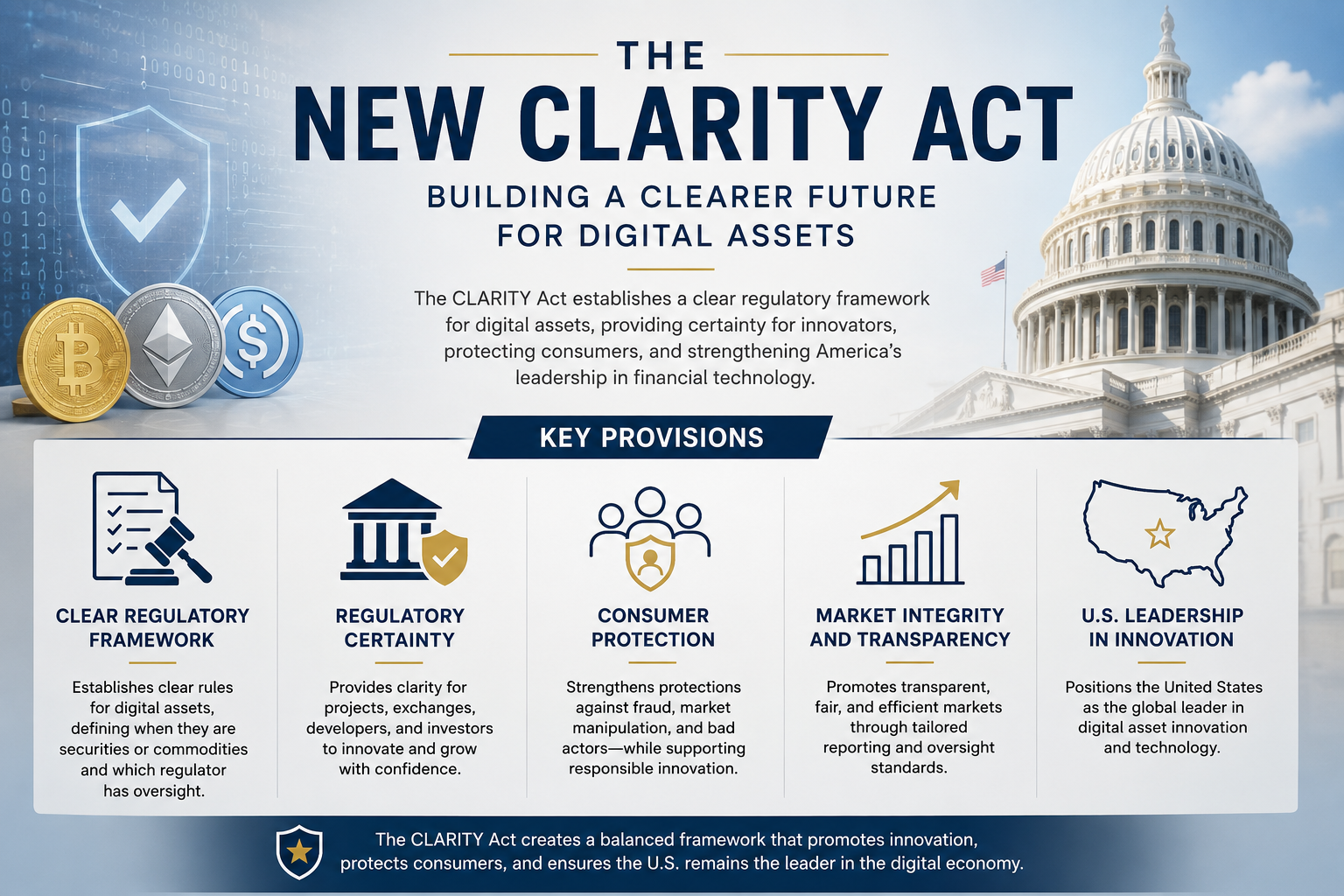 Figure 1: The CLARITY Act represents the intersection of U.S. federal law and the digital asset economy. Image: p2pcompanion.com
Why Does Crypto Need the CLARITY Act?
For nearly two decades, the U.S. crypto industry has operated in what lawyers politely call a "regulatory gap" and what everyone else calls a "mess."
Here's the problem in a nutshell:
- The SEC (Securities and Exchange Commission) believes most crypto tokens are securities — like stocks and bonds — and should follow the same rules.
- The CFTC (Commodity Futures Trading Commission) believes many tokens are commodities — like gold and oil — and should fall under its lighter-touch framework.
- Nobody agreed on where the line was drawn.
Under former SEC Chair Gary Gensler (who left office in January 2025), the SEC filed enforcement actions against Coinbase, Binance, Ripple, Kraken, and dozens of other companies. The message was clear: "We think you're breaking the rules, but we won't tell you exactly what the rules are."
This "regulation by enforcement" approach created several painful realities:
| Problem | Real-World Impact |
|---|---|
| Legal Uncertainty | Companies couldn't confidently build products because they didn't know if they'd be sued next week. |
| Capital Flight | Billions in crypto investment moved to friendlier jurisdictions like the EU (MiCA), UAE, and Singapore. |
| Consumer Risk | Without clear custody and disclosure rules, everyday investors were left vulnerable to fraud and exchange collapses. |
| Innovation Chill | Developers hesitated to build in the U.S., fearing they'd accidentally create an "unregistered security." |
The CLARITY Act aims to fix all of this by replacing ambiguity with a statutory framework — actual laws written by Congress, not opinions expressed through lawsuits.
The Full CLARITY Act Timeline: 2025–2026
Understanding where the CLARITY Act stands today requires looking at how it got here. This is the complete, up-to-date timeline:
2025: Birth in the House
| Date | Milestone | Details |
|---|---|---|
| May 29, 2025 | Bill Introduced | Reps. French Hill, Bryan Steil, G.T. Thompson, and Dusty Johnson introduce H.R. 3633 in the 119th Congress. |
| June 2025 | Committee Markups | The bill clears both the House Financial Services Committee and the House Agriculture Committee with bipartisan support. |
| July 17, 2025 | House Passage | The House passes H.R. 3633 by a vote of 294–134. Every Republican and 78 Democrats vote in favor. On the same day, the House also passes the GENIUS Act (stablecoin bill). |
| July 18, 2025 | GENIUS Act Signed | President Trump signs the GENIUS Act into law. The CLARITY Act, its market-structure companion, moves to the Senate. |
| Late 2025 | Senate Hearings | The Senate Banking Committee holds hearings on digital asset market structure through the fall. Chair Tim Scott (R-SC) and Ranking Member Elizabeth Warren (D-MA) begin negotiating compromise language. |
2026: The Senate Gauntlet
| Date | Milestone | Details |
|---|---|---|
| January 14, 2026 | Banking Committee Postponed | The Senate Banking Committee postpones its markup session. Over 100 amendments had been filed, including the banking industry's stablecoin yield amendment. Chair Tim Scott postpones rather than risk a failed vote. Coinbase CEO Brian Armstrong publicly states Coinbase cannot support the bill as written. |
| January 27, 2026 | Agriculture Committee Acts | The Senate Agriculture Committee, which oversees CFTC-related provisions, holds its markup. The Banking Committee has not yet rescheduled. |
| February 2026 | White House Negotiations | Multiple White House meetings between crypto executives, banking representatives, and lawmakers. The White House sets March 1 as a deadline for a stablecoin yield compromise. Deputy Treasury Secretary Scott Bessent calls for rapid passage, citing the November 2026 midterm elections. |
| March 1, 2026 | Deadline Expires | The White House deadline passes without a public compromise. Negotiations continue behind closed doors. |
| March 8, 2026 | Trump Statement | President Trump posts on Truth Social that he will not sign any legislation until the SAVE America Act clears Congress, placing the CLARITY Act further back in the legislative queue. |
| March 10, 2026 | Summit & Compromise Talks | Senators at a crypto summit say they are working on a stablecoin yield compromise. The American Bankers Association continues lobbying against any yield provision. |
| May 12, 2026 | Senate Banking Text Released | The Senate Banking Committee releases a 309-page compromise text incorporating changes on custody, insolvency treatment, and SEC-CFTC jurisdictional handoff. |
| May 14, 2026 | Banking Committee Vote | The Senate Banking Committee votes 15–9 to advance the compromise text. All Republicans plus Democrats Ruben Gallego and Angela Alsobrooks vote in favor. Elizabeth Warren files 44 amendments; most are rejected. |
| July 2026 | Delay Provision Debate | Reporting surfaces a debate over whether to include an 18–24 month transition window for compliance. The delay language is under active negotiation. |
| August 7, 2026 | Practical Deadline | The last scheduled Senate workday before the August recess. If no vote occurs, the bill must wait until September — with reduced momentum. |
📌 Prediction markets currently price 2026 signing odds at approximately 72%, according to industry data from CoinShares and Polymarket.
Figure 2: Visual timeline of the CLARITY Act's legislative journey through Congress. Image: DataWallet
Six Things the CLARITY Act Actually Does
The CLARITY Act is a dense, multi-title piece of legislation. But strip away the legal jargon, and it does six things that genuinely matter:
1. Classifies Digital Assets Into Three Categories
The bill creates a statutory classification system:
- Digital Securities → SEC jurisdiction (investment contracts, ICOs, centralized token projects)
- Digital Commodities → CFTC jurisdiction (blockchain-native tokens like Bitcoin, sufficiently decentralized assets)
- Stablecoins → Shared SEC-CFTC oversight (with Treasury Department coordination)
This ends the years-long "is it a security or a commodity?" litigation that has defined crypto regulation.
2. Gives the CFTC Authority Over Spot Crypto Markets
Currently, the CFTC only has anti-fraud and anti-manipulation authority over commodity spot markets — not comprehensive oversight. The CLARITY Act expands CFTC authority to regulate digital commodity exchanges, brokers, and dealers at the federal level for the first time.
3. Creates a Provisional Registration Regime
Companies that register during an initial 180-day window operate under provisional status while the CFTC finalizes its rules. During this period, they must protect customer assets and allow CFTC access to books and records. This provisional authority sunsets after four years.
4. Protects Decentralized Finance (DeFi)
The bill includes the Blockchain Regulatory Certainty Act (BRCA) embedded in Section 604. This protects non-custodial software developers — people who build open-source wallets and protocols that don't hold user funds — from being classified as money transmitters.
⚠️ Important caveat: Centralized intermediaries that interact with DeFi protocols (custodial services, aggregators with control) still face compliance requirements.
5. Creates a New Capital-Raising Pathway
Current securities law wasn't written for blockchain-based fundraising. The CLARITY Act introduces a disclosure regime tailored to digital commodities, giving projects a workable route to raise capital without the full weight of traditional securities registration.
6. Bans Federal Reserve Retail CBDCs
The bill includes the Anti-CBDC Surveillance State Act provision, which prohibits the Federal Reserve from issuing a central bank digital currency directly or indirectly to individuals. This reflects concerns about government financial surveillance.
SEC vs. CFTC: Who Regulates What?
The heart of the CLARITY Act is the jurisdictional split between America's two most powerful financial regulators. Here's how it works:
Figure 3: Comparison of traditional financial infrastructure versus digital asset tokenization platforms. Image: Banking.Vision
Under SEC Oversight (Securities)
The SEC retains jurisdiction over:
- Investment contract assets — tokens where investors expect profit from the efforts of a central team
- Initial Coin Offerings (ICOs) and primary market fundraising
- Tokenized securities and traditional financial instruments on blockchain
- Any asset that functions as an investment contract under the Howey Test
Under CFTC Oversight (Commodities)
The CFTC gains jurisdiction over:
- Digital commodities — tokens intrinsically linked to a blockchain whose value derives from network use
- Spot and cash markets for digital commodities (a major expansion of CFTC authority)
- Digital commodity exchanges, brokers, and dealers
- Derivatives and futures markets (which the CFTC already regulates)
The "Mature Blockchain Test"
This is the mechanism that allows tokens to transition from SEC to CFTC oversight. Think of it like a startup where founders initially hold most equity. Over time, ownership spreads across many shareholders. The mature blockchain test captures a similar transition for crypto networks.
Key criteria include:
- No single entity or affiliated group controls 20% or more of token supply or voting power
- The code is open-source
- The token has functional utility beyond investment
- For older chains, at least half of all tokens are held outside the founding team
 Figure 4: Digital tool qualification flowchart used to determine whether a token qualifies as a security under federal guidelines. Image: Buzko Krasnov
The Stablecoin Yield Debate (The Biggest Fight)
If you read nothing else in this article, read this section. The stablecoin yield provision is the single most contentious issue holding up the CLARITY Act in the Senate.
What the Senate Draft Says
The May 2026 Senate Banking Committee draft prohibits crypto platforms from paying yield or rewards on stablecoin deposits that are "economically or functionally equivalent" to deposit interest. However, it allows rewards tied to:
- Transactions in crypto or stablecoins
- Digital payments
- Loyalty programs
- Other services (with rules to be developed jointly by SEC, CFTC, and Treasury)
Why Banks Hate It
The banking industry — led by the American Bankers Association and figures like JPMorgan CEO Jamie Dimon — argues that a stablecoin account paying yield is functionally a savings account. Banks offering savings accounts must follow:
- Deposit insurance requirements (FDIC)
- Capital requirements
- Full federal banking regulation
From their perspective, crypto platforms offering yield without these safeguards are competing on an unlevel playing field — and potentially creating systemic risk.
"This structure would eventually blow up." — Jamie Dimon, JPMorgan Chase CEO, May 2026
Why Crypto Fights It
The crypto industry counters that stablecoin yield is revenue sharing from Treasury bills held in reserve — not a deposit product. They argue:
- Restricting yield damages legitimate business models
- There's no corresponding consumer protection benefit
- It protects incumbent bank profits rather than consumers
For Coinbase, stablecoin-related revenue represented close to 20% of total revenue in Q3 2025. CEO Brian Armstrong has called the yield restriction a provision "designed to protect bank profits rather than consumers."
The Stakes
| If Yield Is Restricted | If Yield Is Allowed |
|---|---|
| Crypto platforms lose a major revenue stream | Banks face direct competition for deposits |
| Stablecoin adoption may slow | Consumers earn competitive returns |
| Banking industry protects its margins | Potential regulatory arbitrage concerns |
| Coinbase, Circle, and others must pivot business models | DeFi protocols may gain relative advantage |
This disagreement has been the primary obstacle to Senate passage since January 2026. As of late July 2026, negotiations continue with no public resolution.
How the CLARITY Act Treats DeFi
Decentralized Finance (DeFi) is one of the most innovative — and hardest to regulate — corners of the crypto world. The CLARITY Act attempts a nuanced approach:
What's Protected
- Non-custodial developers who build open-source protocols
- Validators and node operators who process transactions but don't control user funds
- Software developers who cannot unilaterally move or freeze assets
What's Regulated
- Centralized intermediaries that interact with DeFi protocols and hold customer funds
- Custodial services that control user assets
- Platforms with administrative functions that can freeze, reverse, or modify transactions
The Key Test
The critical question is: Can the developer or provider unilaterally move or freeze user assets?
- If NO → Likely exempt under the BRCA carve-out
- If YES → Subject to registration and compliance requirements
Both the SEC and CFTC retain anti-fraud and anti-manipulation authority over all digital asset activities, regardless of decentralization.
The 'Mature Blockchain Test' Explained
Let's make this concrete with an example.
Imagine a new blockchain project called "GreenChain" launches in 2024. In the beginning:
- The founding team holds 60% of all tokens
- The code is partially closed-source
- The token's main use is speculation (people buy hoping the price goes up)
- The team makes all governance decisions
Result: GreenChain's token is almost certainly a security under the CLARITY Act. The SEC has jurisdiction.
Now fast-forward to 2028. GreenChain has evolved:
- The founding team holds only 15% of tokens
- The code is fully open-source on GitHub
- The token is used to pay for decentralized storage, compute, and identity verification
- Governance is conducted through a DAO with thousands of participants
- No single entity controls more than 5% of voting power
Result: GreenChain's token now passes the mature blockchain test. It can be reclassified as a digital commodity under CFTC jurisdiction.
This "graduation" pathway is one of the CLARITY Act's most elegant features — it acknowledges that blockchain networks, like startups, evolve over time.
What Happens If the CLARITY Act Passes?
If the CLARITY Act becomes law, here's the practical roadmap:
Immediate (0–180 Days)
- CFTC establishes the **expedited registration process** - Companies have **90 days** to register once processes are established - Provisional registrants must protect customer assets and allow CFTC access to recordsShort-Term (180 Days–1 Year)
- Joint SEC-CFTC rulemakings begin to define "digital commodity" and other key terms - Stablecoin reward rules are developed by SEC, CFTC, and Treasury - Exchanges begin adapting compliance infrastructureMedium-Term (1–2 Years)
- Most substantive rules under Titles III and IV take effect **360 days after enactment** - The provisional registration window closes after four years - Full federal oversight of digital commodity markets is operationalMarket Impact
- **Bitcoin:** Likely minimal change — it's already treated as a commodity with established derivatives markets and spot ETFs - **Ethereum:** Could benefit from clearer commodity classification - **Altcoins:** Mixed — clearer rules help compliant projects, but may expose those with concentrated control - **Exchanges:** Coinbase, Kraken, and others gain legal certainty but face new compliance costs - **Institutional Investors:** Greater clarity could accelerate institutional adoptionWhat Happens If It Fails?
If the CLARITY Act does not pass in 2026, the status quo continues:
- Crypto companies operate under regulatory uncertainty
- The SEC retains broad discretion to argue that digital assets are securities
- The CFTC's authority over spot crypto markets remains limited to anti-fraud cases
- Enforcement actions continue as the primary form of "regulation"
- Capital and talent continue migrating to jurisdictions with clearer rules (EU under MiCA, UAE, Singapore, Hong Kong)
- The U.S. risks losing its competitive edge in blockchain innovation
⚠️ The political clock is ticking. Midterm elections in November 2026 could shift Senate control. If Republicans lose the majority, the bill's political dynamics change entirely. The practical deadline for a Senate floor vote is August 2026, when campaigning begins in earnest.
How the CLARITY Act Affects You
Whether you're a casual investor, a developer, or just crypto-curious, the CLARITY Act matters. Here's how:
For Everyday Crypto Users
- **Clearer exchange rules:** You'll know which platforms are federally registered and compliant - **Stronger consumer protections:** Registered exchanges must meet custody and disclosure standards - **Tax reporting:** Expanded 1099-DA rules mean more transactions are automatically reported to the IRS - **Stablecoin rewards:** Your ability to earn yield on stablecoins may change depending on the final Senate textFor Developers & Entrepreneurs
- **Legal certainty:** Build with confidence knowing the regulatory boundaries - **Capital-raising pathway:** New disclosure regime for digital commodity projects - **DeFi protections:** Non-custodial developers gain safe harbor from money transmitter rules - **Compliance costs:** Budget for CFTC registration, KYC/AML programs, and auditsFor Institutional Investors
- **Greater participation:** Clear rules reduce legal risk for pension funds, endowments, and corporations - **Market infrastructure:** Registered exchanges and custody providers create trusted on-ramps - **International competitiveness:** U.S. framework rivals the EU's MiCA regulationOfficial Resources & Further Reading
Stay informed with these authoritative sources:
| Resource | Link | Description |
|---|---|---|
| Congress.gov — H.R. 3633 | congress.gov/bill/119th-congress/house-bill/3633 | Official bill text, status, and cosponsors |
| Senate Banking Committee | banking.senate.gov | Hearings, markups, and committee reports |
| Senate Agriculture Committee | agriculture.senate.gov | CFTC-related provisions and markups |
| SEC Crypto Regulation | sec.gov/spotlight/cybersecurity-enforcement-actions | SEC enforcement actions and guidance |
| CFTC Digital Assets | cftc.gov/digitalassets | CFTC oversight of digital commodity markets |
| White House Crypto Policy | whitehouse.gov/ostp | Office of Science and Technology Policy |
| GENIUS Act (Stablecoins) | congress.gov/bill/119th-congress/house-bill/2392 | Already-enacted stablecoin legislation |
Frequently Asked Questions (FAQ)
What is the CLARITY Act in simple terms?
The CLARITY Act is a proposed U.S. law that creates clear rules for how cryptocurrencies are regulated. It divides oversight between the SEC (for securities-like tokens) and the CFTC (for commodity-like tokens), sets registration rules for exchanges, protects DeFi developers, and bans the Federal Reserve from issuing a retail CBDC.
Has the CLARITY Act been signed into law?
No. As of July 2026, the CLARITY Act has passed the U.S. House and cleared the Senate Banking Committee, but it has not yet received a full Senate floor vote or presidential signature.
What is the "mature blockchain test"?
It's a set of criteria that determines when a blockchain is sufficiently decentralized. If a token's network passes — no single entity controls 20%+ of supply, code is open-source, token has functional utility — it can shift from SEC securities oversight to CFTC commodity oversight.
How does the CLARITY Act affect stablecoins?
It builds on the GENIUS Act. The Senate version prohibits passive yield on stablecoins (treating it like bank deposits) but allows activity-based rewards tied to trading, payments, or loyalty programs. This is the bill's most disputed provision.
Will the CLARITY Act regulate DeFi protocols?
Non-custodial developers and truly decentralized protocols are largely exempt under the Blockchain Regulatory Certainty Act carve-out. However, platforms with custodial elements or centralized control over user funds still face compliance requirements.
Does the CLARITY Act affect crypto taxes?
Yes. The bill expands the definition of "broker" for tax purposes, requiring more platforms to issue Form 1099-DA to users and the IRS — similar to how stock trades are reported today.
When is the deadline for the CLARITY Act?
The practical deadline is August 7, 2026 — the last Senate workday before the August recess. If no vote occurs, the bill must wait until September with reduced momentum due to the November midterm elections.
Which crypto assets would benefit most?
Assets seeking to transition from securities to commodity treatment, U.S. spot exchanges seeking federal registration, stablecoin platforms, DeFi protocols with governance functions, and tokenized securities would all be directly impacted.
Final Thoughts
The CLARITY Act represents a watershed moment for American crypto policy. For the first time, Congress is attempting to write a comprehensive statutory framework rather than leaving the industry to guess at regulatory boundaries through enforcement actions.
Whether it passes in 2026 or gets delayed into the next Congress, the CLARITY Act has already changed the conversation. It has forced regulators, lawmakers, and industry participants to grapple with fundamental questions:
- What makes a digital asset a security versus a commodity?
- How do you regulate decentralized systems without killing innovation?
- Should stablecoins compete with bank deposits?
- Can the United States lead in blockchain technology while protecting consumers?
The answers to these questions will shape not just the $2.28 trillion crypto market, but the future of finance itself.
💬 Have questions about the CLARITY Act? Drop a msg oe mail us below or reach out to our team. We'll keep this article updated as the bill progresses through Congress.
Last Updated: July 30, 2026
Disclaimer: This article is for informational purposes only and does not constitute legal, financial, or investment advice. The CLARITY Act is pending legislation and provisions may change. Always consult qualified professionals before making decisions based on regulatory developments.
Related Articles: